


Service Virtualization
Service Virtualization is an advanced solution that enables development and testing teams to simulate the behavior of dependent services, systems or applications that are not yet available or whose access is restricted. This product helps speed up development and testing by eliminating dependency on external systems and allowing teams to work autonomously. Service Virtualization ensures that teams can continuously test their applications in realistic conditions, leading to higher quality and faster software deployment.

Accelerate application development and testing with service simulation
About the product
Simulation of dependent services
Service Virtualization enables development and test teams to simulate the behavior of dependent systems and services that are critical to the operation of applications. This product allows you to create realistic simulations of the behavior of APIs, databases, network services, and other components, eliminating dependencies on external systems.
Accelerate development and testing
The product allows developers and testers to work in parallel and regardless of the availability of external systems, which significantly speeds up development cycles. Service Virtualization enables instant access to simulated environments, eliminating wait times and increasing team efficiency.
Increase software quality
By simulating real-world conditions, Service Virtualization enables you to identify and solve problems in applications early in the development process. This leads to fewer errors in the production environment and increases the reliability and quality of the resulting software.
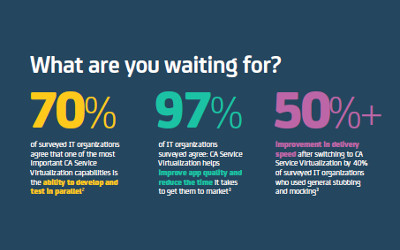
Faster time to market for better apps
What if there are no APIs, microservices, mainframe or third-party systems available for testing? Service virtualization provides DevOps and testing teams across the application development and delivery ecosystem with a chain of API testing capabilities that are automated and easy to maintain-saving time and effort. Our solution enables API virtualization and API test execution at any layer, even for inaccessible or isolated systems.
Service virtualization removes constraints by creating simulations of the systems needed and making them available throughout the software development lifecycle. Developers, testers and performance teams can work in parallel. The result is faster delivery, lower costs and higher quality of innovative new software applications.
How does service virtualization work?

Capture
Recording of traffic: Capture traffic between existing systems.
Create from specifications: create simulations based on engineering specifications.
Leverage multiple sources: draw from sources such as logs, sample data, packet captures and our APIM Gateway.

Retrieved from
Data and protocol evaluation: evaluate the data captured and the protocols used.
Conversion to realistic model: Convert the data to a realistic simulation model.
Simplification for developers: Make developers’ jobs easier by creating an easy-to-use model.
Consistent interface: ensure a consistent interface across supported protocols.

Model
Live model: Create a “living” model that adapts and responds dynamically.
Sophisticated and contextual behaviour: ensure that the model exhibits advanced behaviour depending on the context.
Automatic Dynamic Properties Management:Automatically manage dynamic model properties for realistic simulations.
Key benefits
Parallel development and testing
Allow multiple development and testing teams to work in parallel.
Reduction of infrastructure
Eliminate most of the current demand for environments created by rapid development and testing processes.
Shift to earlier testing
Test earlier in the software lifecycle when troubleshooting is easier and less costly.
Performance testing
Test load at the component level under production environment conditions.
Savings on external services
Avoid the cost of simulating the necessary third-party services.
Accelerate application development, improve quality and reduce costs and risks.
Faster time to market
Accelerate time to market by enabling parallel software development, testing and validation.
Improved application quality
Test earlier in the software development life cycle (SDLC), when it is less costly and less disruptive to resolve application bugs.
Reduce costs and risks
Reduce the demand for development environments or the cost of services charged by usage.
Common use cases

Chaos testing
Use service virtualization to enable testing of negative scenarios

Application testing
Perform stress tests on individual application components using virtual services.

Shift-Left Testing
Use service virtualization to shift testing “left” in your SDLC and increase testing speed by 25-50%.
Testing the mainframe
Remove mainframe restrictions for both distributed and mainframe development.

Component testing
Isolate application components for full testing earlier in the software development life cycle (SDLC).

Third party API testing
Use service virtualization to remove the access restrictions and costs associated with testing third-party APIs.
Grow your digital business with service virtualisation
These benefits are based on real customer outcomes, as reported by Forrester Consulting™.
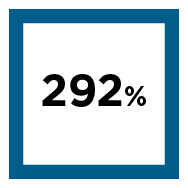
292% return on investment (ROI)

Savings and benefits of USD 6 045 537

2,400 hours saved per issue
How to contact us easily? Leave us a contact.
We’ll give you a call. Free.
Need help or have questions? We are here for you! Email us, call us or fill in the form and we will be happy to answer you. Your satisfaction is our priority.